


Background and Synopsis
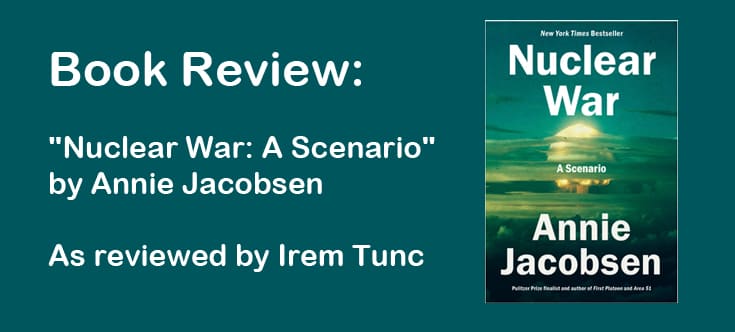
Annie Jacobsen’s Nuclear War: A Scenario is not a book you "enjoy." It is a book you endure. Forget the abstract political discussions and cold war nostalgia; Jacobsen drags the reader into the Situation Room, the missile silos, and the doomed cities to deliver a visceral, thriller-style narrative that feels less like a prediction and more like a live broadcast from the end of the world. As an award-winning, investigative journalist, Jacobsen uses her years of experience, researching declassified documents and interviews with military and CIA experts, to outline a single, very plausible scenario that spirals uncontrollably due to simple miscommunication, automated systems, and a short decision window of 6 minutes for a U.S. President.
The “scenario” kicks off with a warning signal that a single missile has been launched from North Korea. The U.S. nuclear war plan alone can unleash over 1,550 warheads in a retaliatory strike, each one with an explosive power of approximately 30 times that of the Hiroshima bomb. Within those 6 minutes, the President has decided to retaliate, triggering other countries in Europe and Asia to launch their nuclear weapons. In the first hour, each one of these blasts would create a super-heated plume of smoke and soot that would block the sun in its entirety. This would trigger a rapid "nuclear winter," plunging global temperatures by up to 13 degrees Celsius (23°F) within months, leading to a 92% collapse in global agricultural production, ultimately leaving the rest of humanity to starve. There is no winning or rebuilding; this conflict, triggered by a warning signal with imperfect intelligence, is an irreversible, species-ending event.
Why This Feels Terrifyingly Relevant Now
Reading this book in 2025 is a different experience than it might have been in another time, with a different President. Jacobsen’s central thesis is that the system is designed for speed and retaliation, not deliberation. The fate of billions hinges on the judgment, temperament, and stability of a single individual—the President of the United States.
As Democrats, the scenario Jacobsen lays out hits a raw nerve when we consider the emotional instability and childish temperament of Trump. He, and his new Secretary of War, Pete Hegseth, showcased just how dangerous they are during their address to hundreds of our senior military officers. Hegseth mostly just childishly demanded the entire military look and act just like him, but anyone who was still awake during Trump’s remarks heard him mumble, way too casually, that he has sent two nuclear charged submarines off the coast of Russia. “We can't let people throw around that word," Trump said. "I call it the N-word. There are two N-words, and you can’t use either of them. Frankly, if it does get to use, we have more than anybody else. We have better. We have newer. But it's something we don't ever want to have to think about." To be clear, because countries have protocols to launch their nuclear weapons upon merely sensing an attack, it would require only one nuclear bomb to trigger the scenario Jacobsen lays out.
This book is the ultimate argument for the critical importance of elections. It is the most powerful, visceral case imaginable for voting for competence, stability, rational judgment, and a deep respect for the institutions and alliances that have prevented this scenario for 80 years.
It reminds us that the codes are real, the danger is real, and the person we elect must be someone we can trust. Personally, I dream of electing a President that dares to campaign on diplomatically working to dismantle the world’s nuclear arsenal.
Takeaway
Nuclear War: A Scenario is a brutal, but absolutely necessary read. It is a stark reminder that our votes are not just about the economy or social issues. They are about the literal, physical survival of the world (climate change is a whole other conversation).
If this review lit a fire under you, make sure you and every U.S. citizen you know overseas is registered to vote from abroad. Participating in the elections this year and next is our most powerful tool, right now, to ensure stability and rational leadership.
###
Irem Tunc is the chair of the DAGR Thessaloniki Chapter, and an active member of the DAGR Communications team