


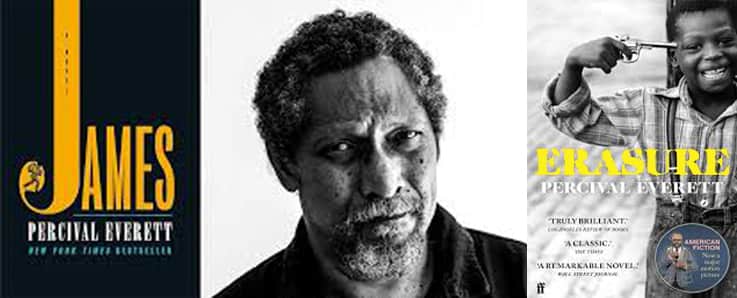
Percival Everett, acclaimed novelist, Pulitzer Prize recipient, poet and teacher, has been writing literary fiction for the past thirty years about the varied experience of African Americans, in both past and contemporary settings. In many of his books, Everett delves into the brutality and discrimination directed against African Americans across the decades, yet he often challenges the role of helpless victim in creating his characters.
In the two novels reviewed, Erasure and James, both main characters, above all, display agency, using their wit and intelligence to surpass limitations imposed on them by the white majority. In both of these novels, Everett also shows how language, both standard and vernacular, is used strategically by the main characters to construct a range of identities for themselves. In sum, Percival Everett is a great story teller who chronicles African American experience with rich descriptive detail and a masterful use of irony.
In this two-part series, Linda Manney leads off with Erasure. Next month, Peter Baiter takes on James.
Erasure
Percival Everett - Review 1 of 2
by Linda Manney
Overview
Erasure is the story of a contemporary African American academic, Thelonious “Monk” Ellison, who is constantly frustrated with other people’s attempts to define his identity according to racist understandings of Black self-expression. Although Monk faces these limitations primarily in white communities, they transcend racial and class boundaries.
A key theme of the book is that racial identity is socially constructed rather than biologically determined, and the author, Percival Everett, develops this idea with irony and humor. Like the main character in Everett’s novel James, the character of Monk in Erasure uses Standard American English and African American Vernacular English strategically as a means to resist racist behavior and beliefs. Erasure addresses questions of race and identity in a thoughtful and sometimes satirical narrative, and Monk as a character is funny, intelligent and warm-hearted.
The main character Monk
Monk comes from a family of doctors: his grandfather, father, and siblings are all doctors; Monk is the lone artist and academic in the family. As an alternative thinker, Monk often feels out of place, in his family as an artist and intellectual and in the local Black community as an odd-ball nerdy kid and later adult who doesn’t know how to “talk the talk.” As an accomplished member of an academic community, Monk is frustrated by expectations of mainstream white academics that he should “be more black.”
In Monk’s experience, “be more black” means to produce according to mainstream expectations of what African American writing looks like: not explorations of classic tragedies or thoughtful analyses of complex literary theory, which is what Monk does well, but rather reiterations of what mainstream white academics and publishers expect from him as an African American writer: stories of Black lives in poor neighborhoods, filled with crime and deprivation, based on racist stereotypes which project demeaning caricatures of Black life.
Development of the plot
Monk suffers from a series of crises, both personal and professional, while also confronting essentialist views of racial identity. Monk’s father committed suicide before the narrative begins, his sister gets killed in a violent attack on a women’s health clinic, his brother is going through a bitter divorce after coming out as a gay black man, and his mother has Alzheimer’s disease. To further complicate Monk’s life, the cost of his mother’s health care has become his responsibility, and he can’t afford it.
As Monk deals with family traumas, his fifth novel is rejected repeatedly by editors and critics, who describe his work as intelligent and well crafted, but not closely related enough to “true African American experience.” At the same time, a trashy novel, We’s Lives in Da Ghetto, makes the best seller list.
Frustrated by the rejection of his novel and the promotion of a book that is an insulting parody of Black life, Monk decides to write his own trashy novel. Using the pseudonym of Stagg R. Leigh, Monk creates an outrageous narrative of African American experience in a poor urban neighborhood.
Chapters of the trashy novel / parody are inserted within the text of Erasure, and have the effect of satirizing mainstream understandings of Black life that Monk has struggled with all his life.
When Monk’s literary agent distributes the manuscript that Monk / Stagg writes sarcastically as a bad joke, a prestigious publishing house accepts the manuscript, offering Monk / Stagg $600,000 as a first installment. After the manuscript is published, a movie producer offers Monk / Stagg $3,000,000 for film rights to the novel, praising the “celebration of African American life” depicted in the book.
The final irony is that a panel of judges, which includes Professor Thelonious Ellison, nominate Stagg R. Leigh’s book for a prestigious book award. Although Monk strongly disagrees with their choice, he is overridden by the other four members of the panel, who praise what they see as the strong merits of the book.
Conclusion
The book ends on the night of the award ceremony, when the audience are about to find out that Stagg R. Leigh, the mysterious and “cool” emergent Black writer, and Thelonious Ellison, established academic and novelist, are one and the same person.
The split-self dilemma of Monk’s life is about to be resolved, Black identity politics reaches a turning point, and the joke is on the audience. But the story is open-ended, so we never find out how Monk / Stagg is received at the awards ceremony.
In sum, I strongly recommend the book Erasure: it explores themes of race and identity in a well constructed narrative that combines critical observation and a quirky sense of humor.
###
Linda Manney is the Thessaloniki Chapter Representative of Democrats Abroad Greece.