


The Beginning Comes After the End
Members of the Jazzy Book Club of Thessaloniki met on Saturday, May 9, at Xarchakos Café, central Thessaloniki, for a lively discussion of Rebecca Solnit’s recently published book The Beginning Comes After the End (2026). In this book, Rebecca Solnit explores particular socio-political developments as the result of long-term resistance to injustice by different people from all walks of life.
During our book club meeting, each of us had the opportunity to speak about an aspect of the book that impressed us in some way and to ask questions or extend the discussion of any of the points raised by the other members.
After our meeting, six of us wrote a short summary of the point(s) we each raised during our discussion, and we have collated our responses in this article. Those of us who contributed are Peter Baiter, Victoria McKethan, Linda Manney and Effie Nabhan, Tony Patrinos, and Nephele Troullinos. Compiled by Linda Manney.
Native Americans’ Struggle to Get Their Land Back
and Restore Its Former Nature
by Peter Baiter
In her provocative book, The Beginning Comes After the End: Notes on a World of Change (2026), Rebecca Solnit declares in Chapter One, “Swimming Upstream,” that one of most exhilarating changes in recent decades is the success of Native American people of North America in reclaiming and repossessing their tribal lands through legal settlement. This constitutes, in Solnit’s words, “the return of land in North America to its original stewards.”
She notes, “Environmental organizations and government departments tasked with land management had, in recent years, begun to recognize that Indigenous stewardship and leadership were among the best ways to restore and protect the land. Indigenous groups had long advocated for that protection and the restoration of their rights.”
The author then describes a remarkable success story, the biggest dam removal project in U.S. history, on the Klamath River, which flows 263 miles from southern Oregon through Northern California into the Pacific Ocean. In the generations before white men came, the river was a spawning ground for Chinook salmon, a basic staple of the Native American diet. Decades after their arrival, white settlers built four dams along the river to support various businesses. As a result, the salmon disappeared, causing havoc and near starvation among Indigenous people.
Indigenous tribes and their supporters undertook a long struggle to remove the dams, which was successfully accomplished in October 2024. Miraculously, shortly afterwards, a Chinook salmon was observed to have swum upstream all the way into Oregon after a lapse of almost a half century. At the same time the dams were being removed, 466 acres of ranch land north of San Francisco were returned to the Federated Indians of Graton Rancheria, a tribal settlement, in perpetuity. As Solnit notes, “Change is made by people who refuse to forget.”
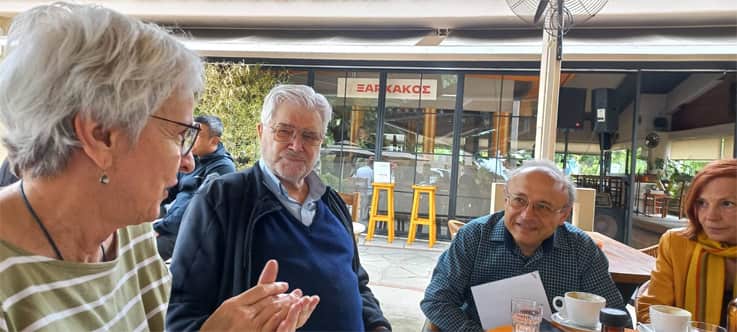
Marion answers questions raised by Peter, Tony and Yiota.
In Chapter 8, “The River Widens,” the author revisits the key role of Native Americans during the last few decades in demonstrating that change is possible, the old and destructive order can be stopped and a new beginning can emerge.
Rebecca Solnit was raised in Novato, Sonoma County, adjoining San Francisco, an area where many smaller Indigenous tribes lived before the white man came.
Native Americans / Indigenous people believe that all things in our lives and the natural world are interconnected, a theme which recurs throughout Solnit’s book. Solnit spent her formative years in close proximity to Native American communities, and this experience has deeply impacted her thinking: she is close to nature, and draws the strength of her convictions by observing the power of nature, particularly its ability to heal itself and project the feeling of connection throughout the world.
In the early 1990’s Rebecca Solnit became actively involved in various Native American movements to reclaim their lands; she sums up the miracle of their successes as follows:
“The Indigenous cultures despised as primitive, dirty and defeated in my youth were being looked to for guidance and models to get us to a viable future. Inconceivable only a few decades earlier, it was an astonishing change that took place mostly in millimeters, not miles, but they added up.”
The land is again seen as a living being, not a thing to be exploited. The so-called triumph of European and Christian civilization is seen as one of separation and violence, bringing about the extinction of species and the destruction of nature.
In closing, Rebecca Solnit dedicates her book to “Those who recognize that while we can’t save everything, everything we can save matters.”
Ordinary People Change the World through
Consistent Acts of Courage and Determination
by Victoria McKethan
In The Beginning Comes after The End, Rebecca Solnit reminds us of the power of transformation, suggesting that ordinary people can change the world. In the second chapter her thesis is set; she uses a metaphor from nature to make her point more clearly, suggesting that ideas spread like seeds, taking roots as laws and rights. Once released, ideas are difficult to destroy, as witnessed in the strong counterreaction to the 2022 overturn of Roe v. Wade.
Solnit refers to Italian philosopher Antonio Gramsci's passage about the old world dying and a new one struggling to be born, and recognises Donald Trump's "Make America Great Again" movement as manifestations of the dying old order. She also reminds us of the dangers of being poisoned by pessimism, and she gives us many reasons to keep up our resistance.
As the author reminds us, you do not need extraordinary power or fame to make a lasting impact, just a strong sense of commitment and everyday actions of resistance.
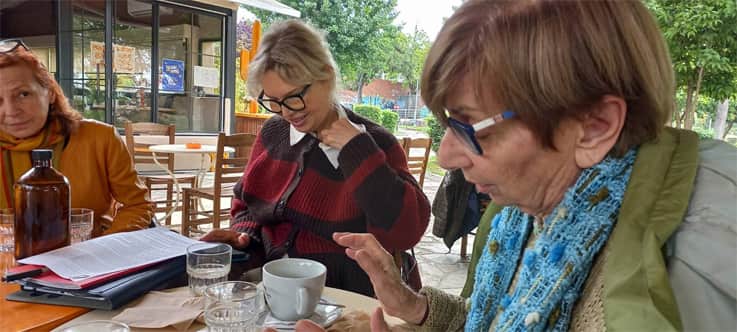 Victoria and Effie discuss the use of imagery to illustrate a point.
Creative use of language in
The Beginning Comes After The End
by Linda Manney and Effie Nabhan
In her 2026 book, Rebecca Solnit uses metaphors and images from everyday life to describe major events from recent times in the USA and beyond. She does this intentionally, to put a positive spin on contemporary reality and to renew our optimism in an era where racism, misogyny and class bias are clearly on the rise.
Solnit uses metaphor to represent broader patterns of social change as the birth of the new world which follows the death of the old world. The new world being born is an accumulation of progressive victories, such as The Civil Rights Act, 1964; *The Voting Rights Act, 1965; The Clean Air Act and Clean Water Act, 1970; the criminalization of marital rape all 50 USA states, 1993; and the removal of four dams on the Klamath River, Pacific Northwest, to reestablish traditional Native American fishing practice, 2024. In Solnit’s extended metaphor, the struggles of progressive groups to enact social change are birth pangs; the resulting social change is part of the new world being born. At the same time, however, powerful opponents see that the old world of privilege and wealth is dying, so they fight to resist or reverse social change.
Solnit also uses familiar images, such as network versus hierarchy and interconnectedness versus isolation to describe major social and political developments, past and present. By using imagistic language, she suggests that historical change is best understood, not as linear sequences of individual actions, but as a woven tapestry of connected components. By using metaphors of birth and regeneration, Solnit takes charge of the narrative, shifting our attention from despair over setbacks to the fight for justice.
*Note: The book was published before the recent Supreme Court decision that undermined Section 2 of the Voting Rights Act.
In defense of Richard Dawkins
by Anthony Patrinos
Overall, I found Rebecca Solnit’s (2026) book profound — eloquent and brimming in fact-based positivity — but her reference to Richard Dawkins, whose work I have been intimately acquainted with for over 35 years, and to The Selfish Gene, is quite unfair.
Solnit frames Dawkins as an opponent of cooperation and symbiosis, contrasting him negatively with biologist Lynn Margulis and her work.[i] First, she quotes selectively, truncating a passage from The Selfish Gene at precisely the point where Dawkins qualifies his argument, explicitly stating that he is not advocating selfish behavior as a moral ideal and even expressing a wish to build cooperative, generous societies. Second, she fundamentally misreads the book's thesis: ‘selfish’ is a technical (albeit maybe too anthropomorphic) metaphor for gene behavior at the molecular level, not a prescription for human conduct. In fact, much of Dawkins’ book explains how the evolution of altruism and cooperation in kin and societies of all species can be elegantly explained by the Selfish Gene theory.
Sadly, she also launches an ad hominem attack, which I think stems from their political differences, reproducing the claim that Dawkins is now ‘more infamous than famous’ for The Selfish Gene, when in fact its reputation remains strong, as a quick Google/AI search will attest to. Any personal notoriety of Dawkins stems from his militant atheism and social media conduct, neither of which has anything to do with The Selfish Gene.
So, in the end I think Solnit could have invoked Dawkins as an ally instead of an adversary.
[i] In the book she strangely references him praising Margulis! In fact, the reference was to an obituary he wrote after her death. They were scientific adversaries when she proposed her Endosymbiosis theory.
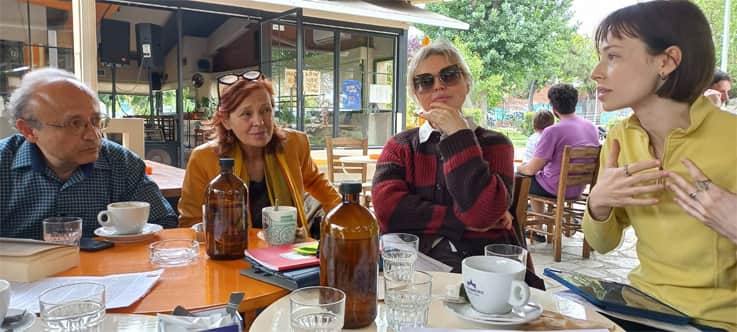 Nephele describes her impressions of the author’s style.
Making Room for Hope
by Nephele Troullinos
I appreciated Solnit’s book from first page to back cover. She reminds us that progress is constant, that present crises do not mean regression, and that ideas and movements take root long before their fruits are visible. What took me by surprise was how I began expecting the book to lift the heaviness I feel about today’s crises. It made me more aware of my own hunger for hope.
Solnit clearly shows us the arc of progress, with its double-edged pattern and long timelines. I can understand today’s crises as part of that arc, but I still feel their heaviness. As Solnit illustrates with Jim Crow after Reconstruction, a backlash might be like a dying supernova, but at its most powerful can harden into violent laws and institutions with damage lasting for generations. Even as the old order weakens, it can leave behind newer but still damaging forms of itself. So while the book gives me much-needed perspective, it also made me realize that perspective alone does not dissolve the pain of living inside or witnessing the damage that remains. The book left me with an acute sense that optimism is not what I feel, but neither is pessimism.
Ultimately, for me, the book’s gift is not only the perspective and wisdom it offers, but that it prompted me to examine what I would need in order to feel hope more fully. Idealistic or naive as it may be, for me that would mean seeing a pattern of progress where harmful reactions are starved and less able to harden into forces that govern and damage our living world.
###