


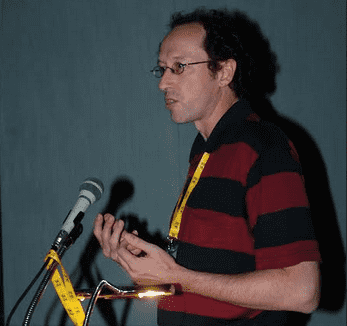
Christian Gross
A Geologist, Activist, and Flute-Playing Visionary
I was actually born in Germany, but my story quickly became transatlantic. When I was just six months old, my parents emigrated to Sandusky, Ohio—a small city on the shores of Lake Erie. That’s where I grew up, graduated from Sandusky High, and eventually became a naturalized U.S. citizen during elementary school.
I studied geology at Beloit College in Wisconsin, and after graduating, I headed west to Oregon. Portland was my first stop—where I worked odd jobs, then for a coffee company, and eventually got my first taste of political engagement through the League of Conservation Voters (LCV), an environmental PAC. That opened a new path for me.
Later I moved to Ashland and joined a cooperative organic food store before landing a dream role as a geologist with the Rogue River National Forest. We were conducting applied groundwater research, and I absolutely loved it. When that project ended in 1990, I returned to Portland and worked with the Mt. Hood National Forest on a range of geological projects.
Fast forward to today: I’ve left the University of Göttingen and am in the process of becoming a freelance geological consultant. I’m collaborating with a colleague in the field of monument restoration—think ancient temples like Angkor Wat and the stones that built them. I also have
years of scientific data I’m analyzing and preparing for publication, including a paper on radioactivity in natural stones used in homes and buildings.
Beyond geology, I have a deep passion for music—I play the flute and love jazz, classical, and world music. I’m married to an incredible German woman who researches lemurs in Madagascar, and I’m deeply committed to protecting the natural world. I’m both disturbed and inspired by the vastness of the universe (or multiverse!) and the challenges we face here on Earth.
Why I Ran for Chapter Chair
At our chapter’s Thanksgiving meeting in 2018, former chairs Ann Marie Bessette and Ben Sandidge approached me about running. I was honored—but resitant. I was buried in research for a major book project on Armenia and working on three scientific papers about natural stone. Still, I decided to say yes. I served two terms as Chair, and later another term as Vice Chair.
About Our Chapter
Our region is large and includes cities like Braunschweig, Göttingen, Hannover, and Kassel—many of which are university towns. We currently have 453 members. While we lost our Kassel precinct captain in 2021, we’re lucky to have one in Braunschweig. The energy dipped during the pandemic, but recent meetings—especially in Braunschweig—have breathed new life into us. With support from Cameron in the Berlin chapter, we also had a great experience at the Magdeburg CSD, where we connected with two new American volunteers. That tiny seed now needs watering and care.
Words I Live By
I’ve collected quotes for decades—from scientists, philosophers, artists, civil rights activists, and spiritual leaders. I don’t have a single favorite, but right now, three come to mind that feel incredibly relevant.
One is by James Baldwin, whose words Bruce Springsteen recently echoed at a Berlin concert. Another is from Nelson Mandela. And the third is from Representative John Lewis, who taught us all the value of “good trouble.”
“There may not be as much humanity in the world as one would like to see. But there is some. There's more than one would think... The world is held together, really it is held together, by the love and the passion of very few people. Otherwise, of course you're in
despair.”
— James Baldwin
“To deny people their human rights is to challenge their very humanity.”
— Nelson Mandela
“A democracy cannot thrive where power remains unchecked, and justice is reserved for a select few. Ignoring these cries and failing to respond to this movement is simply not an option — for peace cannot exist where justice is not served.”
— John Lewis