


 By Charlotte Lamer, Democrats Abroad Paris Chapter Blog Coordinator
Every time I look at the headlines, I want to scream. I’m 19, a dual French and American citizen, living in Paris and studying political science. You’d think being halfway across the world would create some politico-emotional buffer, trust me, it hasn’t. If anything, it feels worse. The geographical distance makes it feel like I can’t do anything about it. And I hate it. I hate what’s happening to America.
A part of me still wants to believe in the America I grew up in. The one where democracy mattered, where freedom of expression wasn’t challenged, when I didn’t have to worry that the things I write might come back to bite me. That if things went wrong, people would call them out.
Now, I’m not so sure. Our rights? Attacked. Our democracy? Eroding, flawed, if you can still call it that. The truth? Bent, twisted, weaponized.
Maybe it's the political scientist in me, but I fail to understand how some people are slowly accepting and signing it off like it's normal. Since when did the unacceptable become normal? And yet, what can we do about it?
How do we challenge the system?
That’s exactly what Harvard Professor Erica Chenoweth and coauthor Maria J. Stephan set out to answer in "Why Civil Resistance Works" (2011).
Spoiler: the answer is in the title. Non-violence: boycotts, protests, sit-ins, basically mass non-cooperation topple authoritarian power structures.
Chenoweth and Stephan studied 323 campaigns worldwide from 1900 to 2006. These included all major violent and non-violent campaigns for the overthrow of government or territorial liberation – what they call ‘maximalist’ and non-reformist movements. Maximalist as in completely altering the political system, not just asking for policy changes. Think: the Philippines’ People Power Movement, the Polish Solidarity Movement.
Here’s what they found:
- Nonviolent protests are twice as likely to succeed as their violent counterparts
- In every case where 3.5% of a country’s population actively took part, the movement achieved significant socio-political change.
In the U.S., that’s a bit more than 12 million people, or roughly Paris’ metro area. WOW.
How Can So Few People Make Such an Impact?
Because active resistance disrupts the status quo in powerful ways.
The changes demanded are often applicable to more than the 3.5% mobilized, meaning the 3.5% draw out “public sympathy” and “support”.
Mobilization is not only about protests. It can also look like walkouts, solidarity networks, refusals, street art, and specific boycotts.
This growing cascade of demands triggers defections within the establishment (think business, media, political, religious elites) who sense that socio-political change is inevitable. Chenoweth terms this process ‘shifting loyalties’.
If you're thinking what I'm thinking, the 3.5% rule works like a waterfall. A sister recognizes a brother. A cousin, a neighbor, a colleague. And the wave builds and builds and builds until change becomes inevitable.
Why does nonviolence work so well?
I see it as its ‘ordinariness’ drawing us in: It’s inclusive. It’s accessible. It’s visible. And it’s contagious. Once people show up, it encourages others to do the same.
It welcomes the risk-averse, the pissed-off, the anxious, the not-so-political-until-now, the somewhat committed, the desperate, the losing-hope, the hopeful.
It’s representative across gender, race, physical ability, rural-urban lines, political party, etc.
Change does not belong to the majority. It belongs to the small vocal minority who have the courage to stand together in opposition to tyranny.
But wait, what does the 3.5% rule really mean?
It means this: Nonviolent movements, protests, sit-ins, and similar mobilization efforts, with just a small number of individuals, almost always succeed. The 3.5% rule is a pattern, not a rule. It’s an observed trend based on historical cases tied to specific campaigns, rather than a guaranteed formula. Some movements succeed with less, others fail outright.
Yes, I know, 3.5% feels like a lot, but it's nowhere near 50%, let alone 100%.
In other words, change doesn't require everyone. It just needs enough.
Now that's hopeful in these certainly un-hopeful times. So, it's powerful, not perfect.
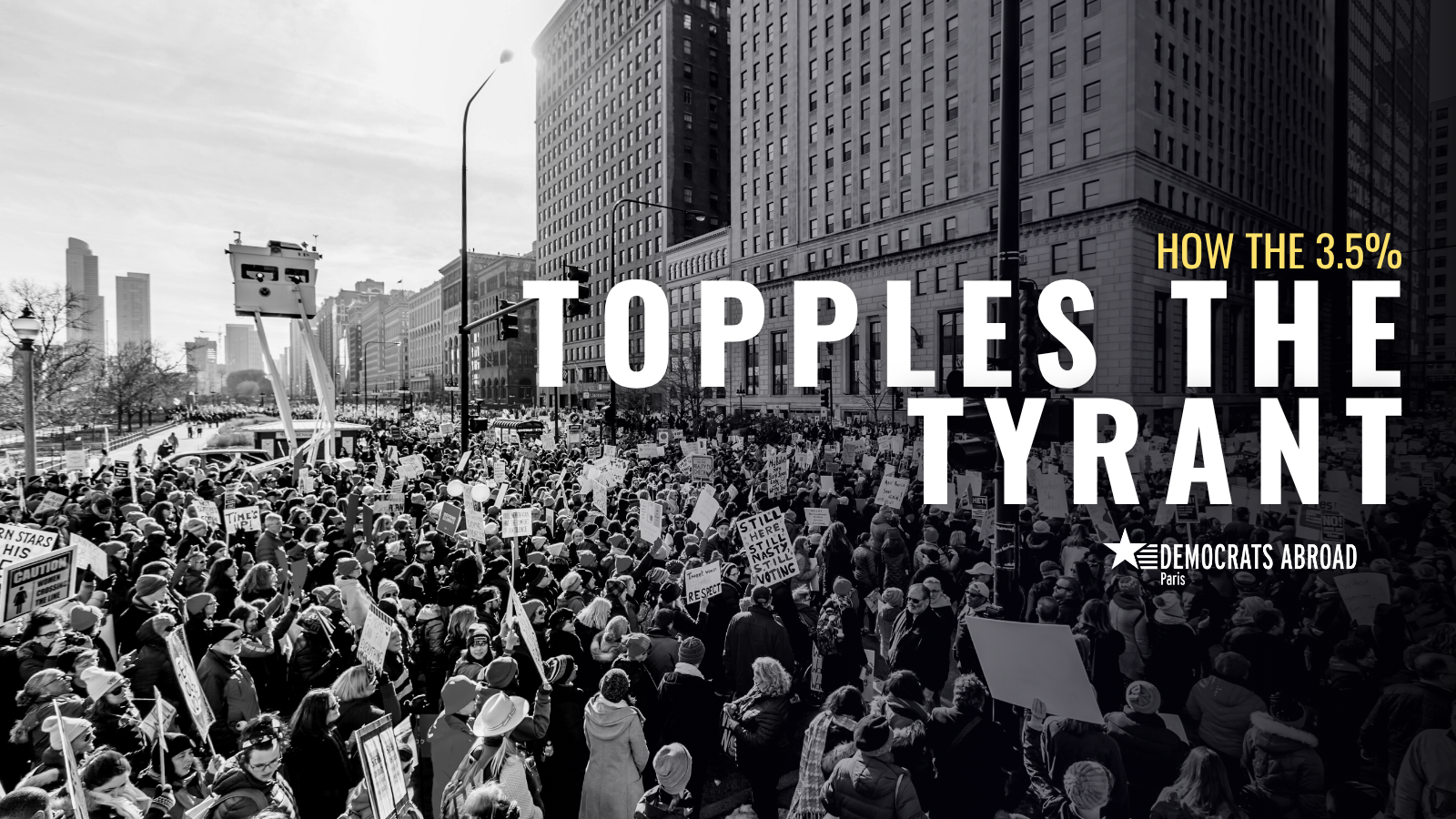
And that 3.5% figure? It means we need everyone to show up together at the same time on one day. That’s exactly what the 4 million folks who showed up on January 21st 2017 for the Women’s March in D.C did.
Curious for more details? Check out Chenoweth’s Q&A paper for a deeper dive into what the number applies to, how it was calculated, and the caveats. See NAVCO 1.2 for a more up-to-date version of the dataset (1945-2014).
But the takeaway? The rule does not account for what Chenoweth puts as “leadership”, “strategic imagination”, “organizational capacity”, or “sustainability.” In other words, these are things the numbers don't measure.
How people were led, mobilized, supported, sustained, organized, how they fought, and why they showed up and continued to speak volumes.
Bottom line: scale and turnout matter, but strategy makes it happen.
What does it mean to be the 3.5% today? It means that you matter, your participation, your voice, your vote, your rage, your fed-up-ness, and your writing. It all matters.
Stay tuned, we have more information coming your way! This is the first of a three-part blog series on the 3.5% protest rule and why it matters today.
How to be a part of the 3.5% with Democrats Abroad France?
- Volunteer in your local chapter - help get the word out, plan the next protest, or support GOTV efforts
- Attend an event in your local chapter and check out Remote Resistance Roundtable sessions held to plan concrete actions to oppose this current administration
- Be a part of the DA Resistance Movement and sign up for Take Actions to be emailed to you
Resources to learn more about the 3.5% rule:
- Watch on YouTube: Erica Chenoweth. 2013. The surprising success of nonviolent resistance. TEDxBoulder, September 21.
- Listen to POD Save America podcast with Erica Chenoweth: “The 3.5% Protest Rule That Could Bring Down Trump”
- Listen to We Can Do Hard Things podcast with Erica Chenoweth: Why Protest Works-The 3.5% Rule
- Read her research paper: Questions, Answers, and Some Cautionary Updates Regarding the 3.5% Rule | Carr Center Discussion Paper Series, April 2020
- Read her book: Chenoweth, Erica, and Maria J. Stephan. Why Civil Resistance Works: The Strategic Logic of Nonviolent Conflict. Columbia University Press, 2011.
- Dig into the data: Chenoweth, Erica; Christopher Wiley Shay. NAVCO 1.2 Dataset
These sources were cited within this article.