


Trump and American Education, Part 3: Trump and the Department of Education
Gregory Sadlek, Chairperson, Brittany Chapter, Democrats Abroad, France
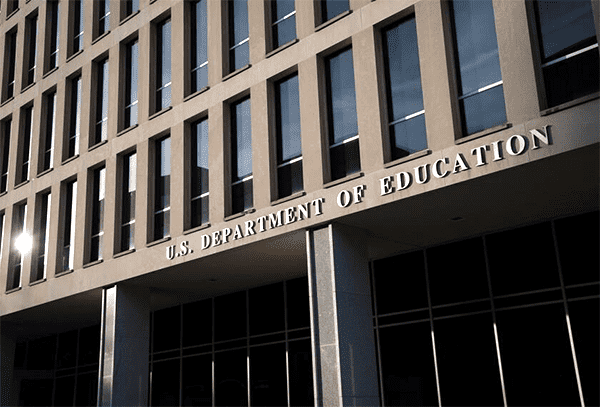
G. Edward Johnson, CC BY 4.0, via Wikimedia Commons
According to the website of the U.S. Department of Education (DOE), local governments and states have the primary responsibility to establish schools and universities, develop the curricula, and determine enrollment and graduation requirements. The first DOE was created in 1867 and was tasked with collecting information to improve American school systems. Over the years, the department’s mission grew. Among its added responsibilities were the administration of land-grant universities, the promotion of vocational training, the providing of additional resources to struggling school districts, the distribution of financial support to veterans who wished to complete a college degree (GI Bill), and, later, to underprivileged college students. Finally, in 1980, Congress established the Department of Education as a Cabinet level agency. In short, the DOE has grown to become a major supporter of American education.
The DOE’s Mission Statement describes how its primary goal is to work with the states and local authorities “to promote student achievement and preparation for global competitiveness by fostering educational excellence and ensuring equal access.” Certainly a worthy goal. However, under the banner of “returning education to the states,” Republicans since Reagan have wanted to deemphasize or even eliminate the department. The second Trump administration has vigorously pursued the goal of reducing and weakening the department, but this administration’s guiding principles for doing so are darker than the traditional states’ rights approaches.
Indeed, the second Trump administration has taken some extraordinarily strong actions against the DOE. In March 2025, for example, the president signed an order to significantly downgrade the department. Thus, since then, the department has lost about 1,700 employees, about half of its staff. The area suffering one of the worst cuts was the office managing student aid, which lost about 40% of its staff. This caused a notable decline on the department’s abilities to service in a timely way present and future recipients of essential student aid. About 25% of workers in the DOE’s Office of Civil Rights (OCR) were also eliminated, reducing its ability to address civil rights complaints, especially those concerning students with disabilities. In addition, 75% of workers in its Institute of Education Sciences (IES), whose mission is to produce rigorous and non-partisan research to support educational practice, were cut. To make matters worse, DOGE cancelled about $900 million in education research contracts awarded by the IES--deleted under the heading of “waste, fraud, and abuse.”
Some of the reductions to the DOE were made through Interagency Agreements, often moving vital programs to other departments that have only limited expertise in educational matters. For example, 27 grant programs supporting K-12 education as well as 21 postsecondary programs were transferred to the Department of Labor. And twelve international and foreign-language educational programs, including the prestigious Fulbright programs, were transferred from the Office of Postsecondary Education to the Department of State.
To lead the department, Trump chose Linda McMahon, a co-founder of World Wrestling Entertainment (which is a part of a larger company that staged the Ultimate Fighting Championship on the lawn of the White House on Trump’s 80th birthday). Her qualifications for the job included a B.A. in French and an early intent (never fulfilled) to pursue a career in teaching. After serving as head of the U.S. Small Business Association in Trump’s first term, she went on to chair the America First Policy Institute, a think tank focused on advancing conservative educational policy solutions. Not surprisingly, she and her husband had a close, personal connection to Trump. Upon entering office, McMahon proceeded to cut funding from many of the department’s programs, especially those “ensuring equal access.” As of June 17, 2026,Trump’s Office of Management and Budget (OMB) has allocated little or no 2026 congressionally approved funding for 32 of the DOE’s programs (amounting to $1.65 billion). Among these programs are mental health and safety grants, school desegregation grants, and assistance programs for magnet schools. Allocations for Hispanic-serving schools, grants to improve second language education, support for arts education, and minority science and engineering programs were also passed over. These impoundments reflect Trump’s political agenda, almost certainly hindering, if not breaking, the success of some of the least advantaged of America’s primary and secondary students.
Rather than rooting out waste and fraud, all of these cuts follow from the ideological agenda of Trump’s populist politics. Indeed, according to the Brookings Foundation, they neatly fall in line with the right-wing Heritage Foundation’s Project 2025. Moreover, the Brookings Foundation argues that the initiatives of Project 2025 align more closely to the “ethno-traditionalism” of white Christian nationalism than mainline political conservatism. These include proposals rolling back various civil rights protections, including those related to gender identify and transgender students. In fact, in February 2025, the DOE sent “Dear Colleague” letters to all the states, ordering them to eliminate Diversity, Equity, and Inclusion programs related to admissions and hiring or risk the loss of federal funding. Fortunately, after suffering several defeats in the courts, the DOE agreed to withdraw its letter. However, court rulings like these blunt but do not eliminate the Trumpian education initiatives. If the Congress remains Republican after the midterms, we are sure to see more undermining of DOE’s “equal access mission.”
CONCLUSION
In the first of these three articles, I described how educating American citizens has always been a high priority for our country’s leadership. Indeed, the support of the American government and the American taxpayer has built our schools and universities, including both private and public institutions, into one of the world’s most admired educational systems as well as a research powerhouse. The results have included the creation of a literate and informed citizenry as well as tremendous prosperity and also an impressive boost to American soft power. We have seen, however, that the second Trump administration’s backward-looking ideological agenda is degrading the quality, viability, and independence of American education on every level. And here’s the shocking irony: although Republicans often present themselves as defenders of Western Civilization, these initiatives actually represent an attack on Western Civilization because “civilization” is not a static phenomenon. Indeed, diminishing successful educational systems is a good way to cast a civilization into retreat. One need look no further than the attack on liberal education under the Taliban in Afghanistan to see this. Since American education is one of the most important sources of our country’s contributions to Western (and indeed World) Civilization, a diminished national educational system will quickly lead to a diminished America, an America that may produce high quality fake wrestling matches but little to show in cultural, intellectual, and scientific leadership.
On the one hand, Federal courts have generally been courageous in fulfilling their role of impartially analyzing Trump’s questionable directives and then blocking them if illegal. On the other hand, the Congress, with the Republicans in the majority, has cowered in silence. Sadly, those Republican senators and representatives with the courage to take principled stands against Trump have been forced to leave, while the remaining sycophants quickly avert their gaze in silence from the obvious damage that the President and his circle of advisors have wrought. We desperately need, then, a Democratic Congress to bring accountability back to Washington. With the midterms only a few days away, this is our best chance to make that happen. If you haven’t sent in your ballot yet, please do so right away!