


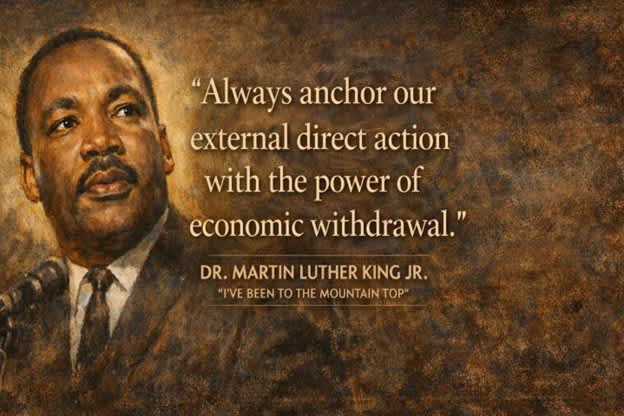
Dr. Martin Luther King Jr. reminded us that protest is not only about visibility, it is about leverage.
In his final speech, I’ve Been to the Mountaintop, delivered April 3, 1968, the evening before he was assassinated, King spoke plainly about economic withdrawal. Not symbolism. Not slogans. Strategy.
That lesson still matters.
We show up. We march. We rally. America is angry, fed up, and determined to protect democracy. But visibility alone has never changed systems.
Economic withdrawal does.
Because the pressure point has always been money.
During the Montgomery Bus Boycott, Black Americans didn’t just protest discrimination, they withdrew participation from an unjust economy. For 381 days, riders walked, organized carpools, and sacrificed convenience. The system destabilized. Leaders were forced to respond. Courts ordered desegregation.
No hashtags. No viral videos.
Just organized people withdrawing participation, changing history.
The strategy hasn’t changed.
What’s changed is Americans standing together, responding as one nation to protect democracy.
Today, that power lives in where we spend, and where we refuse to.
Support small businesses and family-owned companies. Absolutely.
Economic withdrawal from Fortune 500 corporations shifts dollars back into communities and reminds corporate America that they are accountable to the people.
These giants share investors and ecosystems. Losses in one company are recovered in another. That’s the shell game. And when corporations claim neutrality while enabling harm, that isn’t silence. It’s participation.
Many of these corporations throw up their hands and say, “Hey, it’s not us,” while doing nothing to protect democracy.
In the criminal justice system, that’s called being an accessory. And an accessory isn’t just a bystander. It’s a punishable offense.
Silence in the face of harm isn’t neutrality. It’s participation. Real leverage comes when “neutral” corporations start losing money too. That’s when accountability begins.
But this also requires honesty about our addiction to corporate convenience.
These systems operate like drug dealers: first the product is cheap and easy. Then dependency sets in. Then the price rises, financially, emotionally, and democratically. Convenience becomes control.
This isn’t just consumerism. It’s corporate manipulation that turns convenience into dependency, slowly stripping away our freedom of choice.
History reminds us that building economic power isn’t enough. We must also be prepared to defend it.
Black Wall Street showed what happens when dollars circulate locally. Segregation forced Black communities to build their own systems. Greenwood thrived through shared responsibility and self-sufficiency, until resentment turned to violence in Tulsa in 1921.
The lesson is simple: communities sustain democracy, not corporations.
Economic withdrawal isn’t new. It is a civil right.
It looks like essential spending only. Local-first shopping. Libraries instead of buying. Potlucks instead of restaurants. Clothing swaps. Volunteering. Walking with neighbors.
Protest makes us visible.
But our dollars are our power. Our voice and our vote.
Dr. King didn’t die asking us to be patient.
He died reminding us that economic withdrawal becomes moral power when “We the People” move together.
Let’s do this together.
Democratically Yours,
Shelley Bradford Bell
Chair Democrats Abroad France – Paris Chapter & Co-Chair, Democrats Abroad Global Black Caucus France