


Normandy, France –The author of the following opinion piece is Judith Crews, Ph.D., professor, translator, writer, and daughter of two WWII U.S. Navy veterans. Dr. Crews is a Michigan UOCAVA voter, resident of France, and member of the Democrats Abroad Global Veterans and Military Families (VMF) Caucus.
_________
For those unfamiliar with the Pointe du Hoc in Normandy, France, this significant D-Day site near Omaha Beach was the scene of one particular battle that began at dawn on June 6, 1944, when U.S. Army Rangers scaled dangerously high vertical cliffs under heavy fire and managed to neutralize an enemy bunker. The site today looks much the same as when the Ranger Battalion commanded by Lt. Col. Earl Rudder left it following Operation Overlord in 1944, with fortifications, bomb craters, and other signs of the battle that took place 82 years ago. The site is owned by the French administration the Conservatoire du Littoral, and is managed by the American Battle Monuments Commission (ABMC).
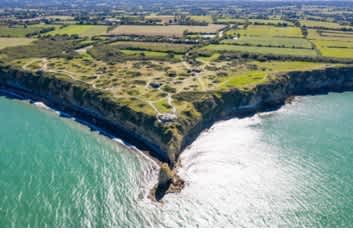
Pictured above: Pointe du Hoc in Normandy, France. Free-use photo retrieved from Pixabay.com.
On February 17, 2026, a groundbreaking ceremony organized by the ABMC was held at the Pointe du Hoc Memorial to follow up on stabilization work begun 16 years ago and to launch a new series of extensive renovations and reconstructions that have been judged necessary for this well-known World War II battlefield. The United States announced that it will provide €10 million for this round of the work that is expected to last 18 months; the site will be partially accessible to visitors during this period.
Improving both the visitors’ experiences and safety at the site are among the stated goals of the renovations, which is the only WWII battlefield managed by the ABMC. Extensive technical surveys have already been undertaken to determine the extent to which it will be necessary to reinforce weakened aspects of the grounds and paths that wind through the bomb-scarred terrain. One important issue that must be taken into consideration is the very large number of visitors per year – over 700,000 in 2024 and 640,000 in 2025 – because these numbers are in themselves contributing to the gradual deterioration of the site. Another, equally significant factor is natural erosion from the high winds and frequent storms in this part of the English Channel. Some of the traditional footpaths are now too close to the cliff edge, the base of the cliffs risk collapsing, and urgent measures are needed to check further deterioration and ensure visitor security for the entire site.
During the ceremony on February 17, several public figures presented details of the upcoming project, including the junior U.S. Senator from Iowa, the Prefect of Calvados, and the Mayor of Criqueville-en-Bessin. There were many references to the courageous sacrifice of “our heroes” who, as Senator Joni Ernst put it, “changed the direction of the war” by scaling the 100-ft. cliffs. Prefect Bredin pointed out that the winds, the tides, and time are inexorably effacing the traces of the Atlantic Wall, along with all that remains of the “symbolic gesture” of courage and freedom of the Allies who came to liberate Europe in 1944.
The Visitor Center, the parking lot, and the paths on the top of the cliffs are all expected to be renovated. And there are plans to revise the presentation of the history of the site so that, as General Michael Xavier Garrett (U.S. Army, ret.) put it, a visit to this memorial will “encourage quiet reflection and learning.”
After the presentations, the elected officials, military officers, and special guests participated in a symbolic groundbreaking with special shovels provided in a small enclosed wooden frame. There was a reception afterwards in the Pointe du Hoc Visitor Center.
But questions inevitably arise concerning the number of times over the past 16 years the U.S. Congress has voted to provide significant funds to renovate this same site. In fact it is difficult to pin down exactly how many millions of dollars and euros have been poured into the Pointe du Hoc. Each of the following interventions – and the list is incomplete – were funded by the United States Federal Government.
● U.S. funding for basic preservation of the site began in 1946 right after WWII under the ABMC.
● Comprehensive restoration and active stabilization of the site became priorities in the early 1970s.
● Large-scale engineering projects were needed by the 1990s to channel surface water directly towards the edges of the cliffs.
● By the 2010s erosion was significant enough to allocate €4.8 million in U.S. federal government funds to reinforce the ground beneath the cliffs and the shorelines.
● In 2019 a €6 million contract was awarded to a French construction firm for a very large stabilization project by the ABMC (with over €10 million in U.S. federal funds).
● A mention in Ouest France dated March 2, 2023 stated that the U.S. federal government would be spending over €16 million on the site.
● The latest U.S. federal contribution is the €10 million announced at the February 17th groundbreaking ceremony…
In the end, no matter how much work is carried out and for how many millions, the weakening of the Pointe du Hoc is one of the inevitable and irreversible results of global climate change. More forceful and destructive winds and waves are eating away at the entire Normandy shoreline, the sandy beaches, and the terrain in an area that was already vulnerable (and partially destroyed) during WWII with the dropping of thousands of tons of bombs. The most recent (and violent) Atlantic storm in early January 2026 broke all wind-velocity records with gusts reaching 213 km per hour; climatologists foresee that this trend will continue. And the famous “point” of the Pointe du Hoc has already collapsed into the sea (on May 5, 2022).
How sustainable can it be to repeatedly fund expensive projects to maintain a WWII historical memorial at all costs with U.S. taxpayers’ dollars for something that is slowly but surely eroding away? And while there are excellent reasons to remember and honor the lessons of history, at what point do we stop pretending about inexorable natural forces and ask for more transparent accountability from the U.S. Congress?
Maybe it takes a different kind of courage to look at the real question: when do we start writing to our elected representatives in the United States and urgently request them to reconsider the millions that are being spent to repair a site destined to fall into the sea very soon?
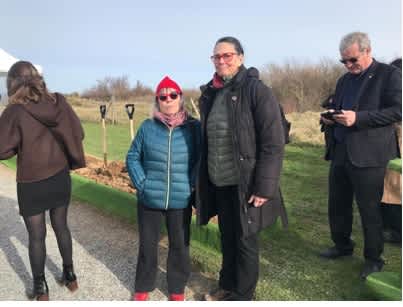
The author of this opinion piece, Judith Crews (center right), attends the February 17, 2026 ABMC event with her colleague Maite Penna (center left) at the Pointe du Hoc in Normandy, France.
__________
U.S. citizens living abroad, both civilian and military, are highly encouraged to check your voter registration status and request your ballot for any upcoming elections in your home voting state that you are eligible to vote in.
The Global VMF Caucus has over 1,400 members in dozens of countries and proudly consists of veterans, military family members, Department of Defense civilians, other national security professionals, and strong allies of veterans and military family causes.
For questions or comments pertaining to this statement, please reach out to